Domain Model
Overview
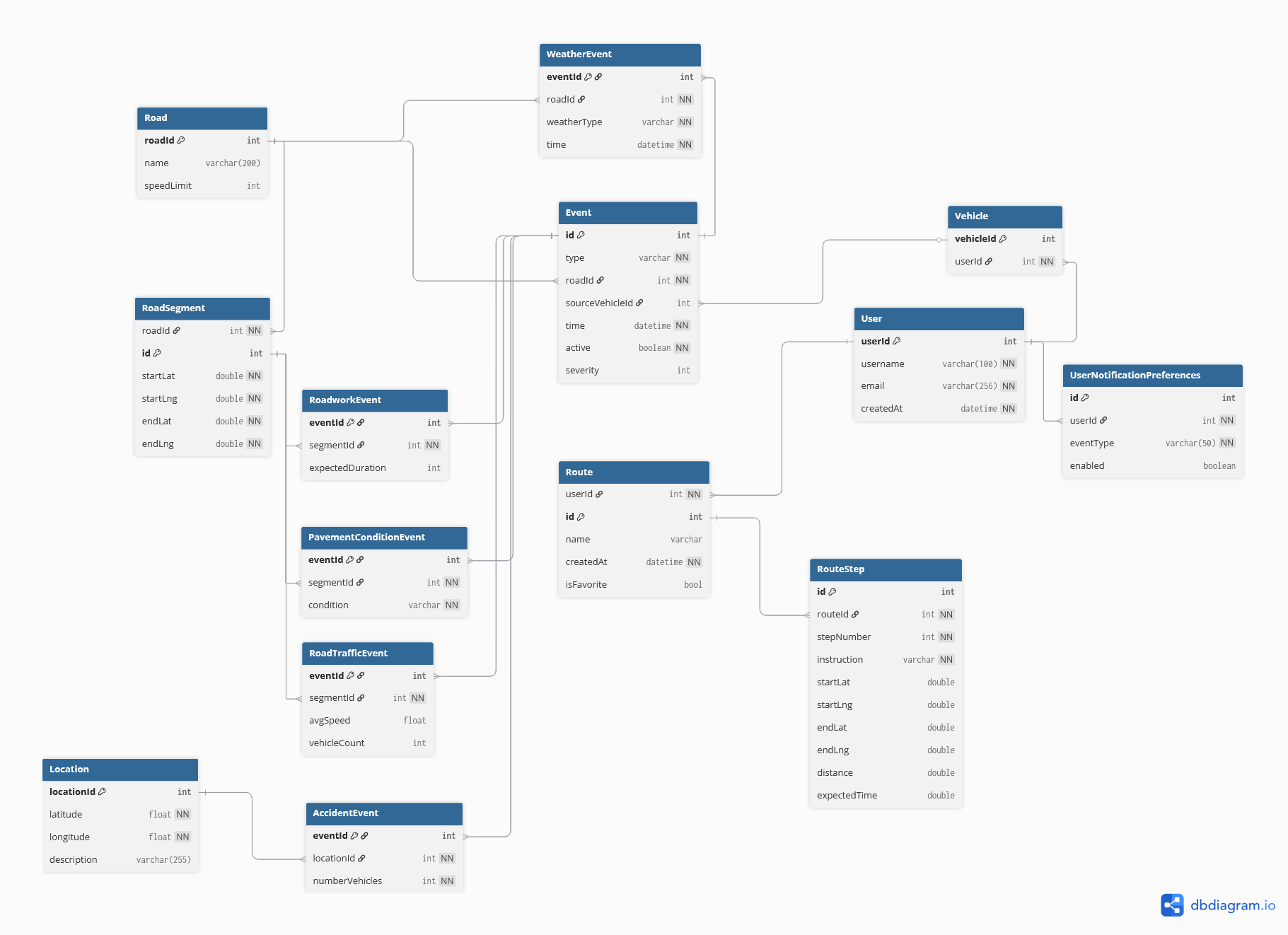
The domain model represents the comprehensive architecture of the road monitoring, event management, and user navigation system. It defines how users, vehicles, roads, routes, and various event types interact to provide real-time information about road conditions, incidents, and personalized navigation experiences.
Key Entities
User
Represents a registered user in the system with:
- userId: Unique identifier for the user
- username: User's display name
- email: User's email address
- createdAt: Account creation timestamp
Vehicle
Represents a vehicle owned by a user with:
- vehicleId: Unique identifier for the vehicle
- userId: Reference to the vehicle's owner
Road
Represents a major road in the system with:
- roadId: Unique identifier for the road
- name: Road name
- speedLimit: Maximum speed limit for the road
RoadSegment
Represents a specific segment of a road with precise coordinates:
- roadId: Reference to the parent road
- id: Unique identifier for the segment
- startAt: Starting latitude coordinate
- startLng: Starting longitude coordinate
- endAt: Ending latitude coordinate
- endLng: Ending longitude coordinate
Location
Represents a specific geographic point with:
- locationId: Unique identifier for the location
- latitude: Geographic latitude
- longitude: Geographic longitude
- description: Location description
Route
Represents a user-defined navigation route:
- userId: Reference to the route creator
- id: Unique identifier for the route
- name: Route name
- createdAt: Route creation timestamp
- isFavorite: Boolean indicating if route is marked as favorite
RouteStep
Represents individual steps within a route:
- id: Unique identifier for the step
- roadId: Reference to the road for this step
- stepNumber: Sequential step number
- instruction: Navigation instruction
- startLat: Starting latitude
- startLng: Starting longitude
- endLat: Ending latitude
- endLng: Ending longitude
- distance: Distance for this step
- expectedTime: Expected time to complete this step
UserNotificationPreferences
Represents user preferences for specific event notifications:
- id: Unique identifier for the preference
- userId: Reference to the user
- eventType: Type of event for this preference
- enabled: Boolean indicating if notifications for that event are enabled
Event
Base entity representing an event that occurs on the road network. Attributes include:
- id: Unique identifier for the event
- type: The type of event (WeatherEvent, RoadworkEvent, PavementConditionEvent, RoadTrafficEvent, AccidentEvent)
- roadId: Reference to the road where the event occurred
- sourceVehicleId: Reference to the vehicle that was responsible for the event (optional)
- time: When the event occurred
- active: Boolean indicating if the event is currently active
- severity: Event severity level
Event Subtypes
WeatherEvent
Represents weather-related events with:
- eventId: Reference to the base event
- roadId: Reference to the affected road
- weatherType: Type of weather condition
- time: Event timestamp
RoadworkEvent
Represents road construction/maintenance events with:
- eventId: Reference to the base event
- segmentId: Reference to the affected road segment
- expectedDuration: Estimated duration of roadworks
PavementConditionEvent
Represents road surface condition events with:
- eventId: Reference to the base event
- segmentId: Reference to the affected road segment
- condition: Description of pavement condition
RoadTrafficEvent
Represents traffic congestion events with:
- eventId: Reference to the base event
- segmentId: Reference to the affected road segment
- avgSpeed: Average speed of traffic
- vehicleCount: Number of vehicles in the affected area
AccidentEvent
Represents accident events with:
- eventId: Reference to the base event
- locationId: Reference to the accident location
- numberVehicles: Number of vehicles involved
Relationships
The domain model illustrates the following key relationships:
User-Centric Relationships
- A User can own multiple Vehicles (1:N relationship)
- A User can create multiple Routes (1:N relationship)
- A User can have multiple UserNotificationPreferences (1:N relationship)
Road Network Structure
- A Road can be divided into multiple RoadSegments (1:N relationship)
- A Route consists of multiple RouteSteps (1:N relationship)
- A RouteStep references a specific Road (N:1 relationship)
Event System
- Event is the base entity for all event types (WeatherEvent, RoadworkEvent, PavementConditionEvent, RoadTrafficEvent, AccidentEvent)
- Events are associated with Roads through the roadId reference
- RoadworkEvent, PavementConditionEvent, and RoadTrafficEvent reference specific RoadSegments
- AccidentEvent references a specific Location
- Events may optionally reference a sourceVehicleId to track which vehicle was responsible for the event
Cross-Entity Relationships
- Vehicles are associated to Events through the sourceVehicleId field
- Events are linked to the road network either through Road references (WeatherEvent) or RoadSegment references (RoadworkEvent, PavementConditionEvent, RoadTrafficEvent)
- Locations provide precise geographic coordinates for incidents like accidents, while RoadSegment provides a designated area for broader events.
Tutors:
- Rafael Direito (rafael.neves.direito@ua.pt)
- Diogo Gomes (dgomes@ua.pt)
Group:
- Diogo Nascimento (dca.nascimento5@ua.pt)
- Duarte Branco (duartebranco@ua.pt)
- Eduardo Romano (eduardo.romano@ua.pt)
- Filipe Viseu (filipeviseu@ua.pt)
- Samuel Vinhas (samuelmvinhas@ua.pt)
Institution: Telecommunications Institute of Aveiro (ITAv)